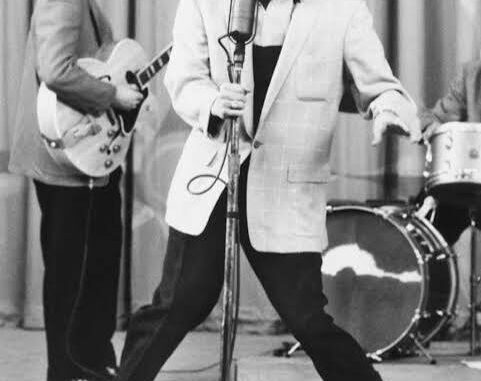
When Elvis Presley took the stage in 1956 to perform *“Hound Dog,”* he could not have fully anticipated the cultural earthquake that would follow. While the song itself was already familiar—having been recorded earlier by blues singer Big Mama Thornton—the controversy that surrounded Elvis had little to do with the lyrics.
Instead, it was his *performance*, particularly his body movement and emotional delivery, that ignited outrage across the United States. Years later, Elvis would reflect on the moment with a simple explanation: he said he wasn’t trying to provoke anyone, that he was just reacting to the *mood he was feeling*, and that there was “nothing attached to it,” just as the words and music were meant to be taken.
The most infamous of these performances came on **The Milton Berle Show** in June 1956. Elvis appeared without his guitar, freeing his body to move with the rhythm of the song. His loose hips, bent knees, and instinctive gestures shocked adult audiences and horrified conservative 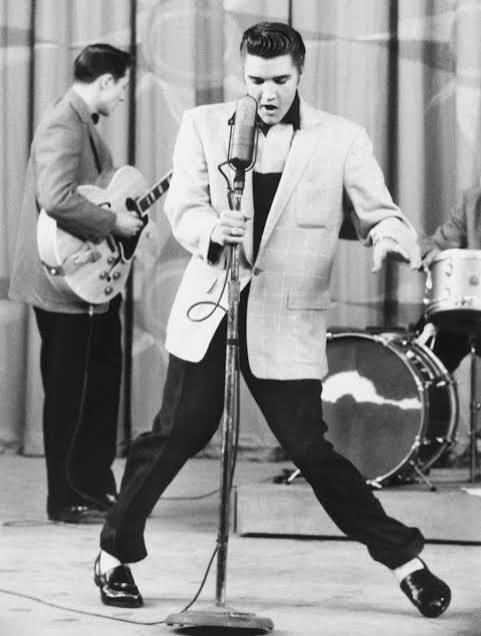
Yet Elvis himself consistently rejected the idea that his performance was sexual or calculated. In interviews, he explained that his movements were not planned or intentional. He insisted he was simply feeling the music in the moment. To Elvis, rock and roll was about energy, emotion, and rhythm—not seduction. He maintained that people were reading meanings into his performance that he never intended. As he famously suggested, there was *nothing attached to it* beyond the feeling the song gave him on stage.
This disconnect between intention and perception revealed a deeper generational divide. To young audiences, Elvis represented freedom, excitement, and a new sound that broke away from stiff traditions. Teenagers screamed, danced, and saw him as a voice of their own emerging culture. To many adults, however, his performances symbolized a breakdown of social order. Rock and roll’s raw energy challenged conservative norms, and Elvis became the lightning rod for those fears.
Ironically, the backlash only amplified his fame. Television networks tried to censor him, eventually filming him only from the waist up on later shows like *The Ed Sullivan Show*. But by then, the damage—or triumph—had already been done. The controversy surrounding *“Hound Dog”* pushed Elvis to even greater heights, turning him into the most talked-about performer in America.
Looking back, Elvis Presley’s explanation remains strikingly simple. He did not see himself as a rebel or provocateur. He was a performer responding honestly to the music, guided by instinct and emotion. What shocked America was not a song, nor its words, but a new form of expression that society was not yet ready to accept. In that sense, *“Hound Dog”* became more than a performance—it became a turning point in popular culture, proving that music could move bodies, challenge norms, and change history, even when the artist insisted there was nothing more to it than the feeling of the moment.
Leave a Reply